1. The Freddo Phenomenon: Greece's Greatest Cold Brew Revolution
While northern Europe relies on hot filter coffee and the Americas popularized iced drip with milk syrups, Greece engineered what coffee scientists regard as the ultimate expression of iced espresso: the Freddo Espresso and Freddo Cappuccino.
Created in Athens during the early 1990s, the Freddo requires pulling a double shot of hot, concentrated specialty espresso directly over several dense ice cubes. The mixture is instantly aerated inside an industrial spindle mixer (the frapiere) for exactly 8 to 12 seconds. This rapid thermal shock creates a micro-foam that traps volatile aromatics while chilling the liquid instantly without dilution.
"The Freddo is not just cold coffee; it is a thermal architecture designed specifically to sustain nuanced citrus and floral tasting notes beneath a blazing Mediterranean sun."
2. The Briki & Hovoli: Sand-Brewing Since Byzantine Times
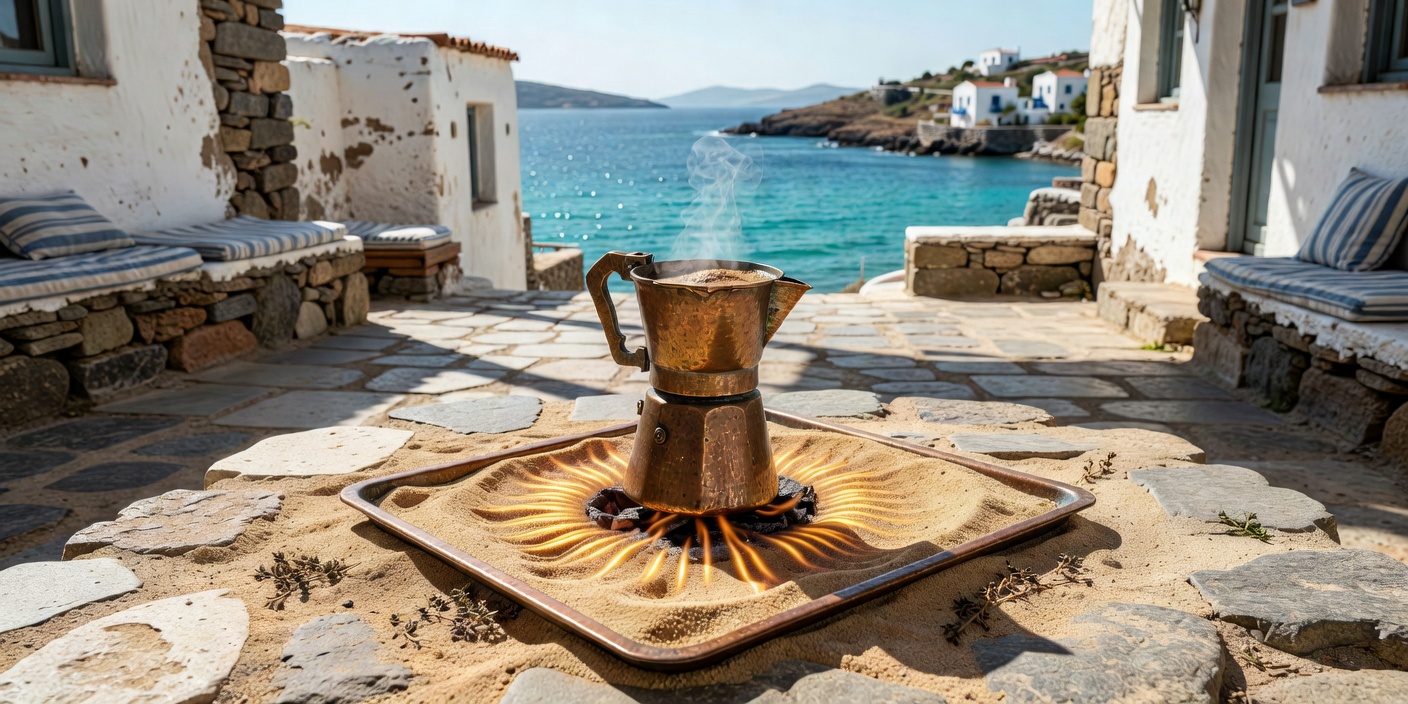
Before espresso machines arrived, the heart of Greek coffee lay in the hovoli—a large copper tray filled with fine sand heated from beneath. Very finely pulverized, unwashed Arabica beans are blended with cold spring water and raw cane sugar inside a solid brass or copper vessel called a briki.
By shifting the briki across different heat zones in the hot sand, the barista carefully manages the boil. The goal is to lift the thick, dense foam (kaimaki) to the rim three distinct times without letting the bubbles burst. When poured slowly into a small porcelain demitasse, the grounds settle into a thick velvet silt at the base, leaving a rich, chocolatey infusion with intense body.
How to Order Traditional Greek Coffee like a Local:
- Sketos (Σκέτος): Pure black, zero sugar. Intense, bitter, complex cocoa notes.
- Metrios (Μέτριος): Medium sweet (one teaspoon coffee, one teaspoon sugar). The gold standard balance.
- Glykys (Γλυκύς): Sweet (two teaspoons of sugar). Smooth and dessert-like.
- Varyglykis (Βαρύγλυκος): Extra strong and sweet, boiled multiple times for dense foam.
3. The Kafeneio: An Architectural Anchor of Greek Civil Society
In almost every village square from the peaks of the Pindus Mountains to the sun-bleached ports of the Dodecanese, the central gathering node remains the kafeneio. Recognized by its rush-seated wooden chairs, marble-topped tables, and ubiquitous sounds of clicking tavli (backgammon) dice, this space transcends retail.
Here, a customer can sit with a single €2.50 coffee accompanied by a chilled caraffe of spring water and a spoon sweet (glyko tou koutaliou) for six hours uninterrupted. The architecture is intentionally transparent: tall open shutter doors facing the public square invite every neighbor into the conversation.